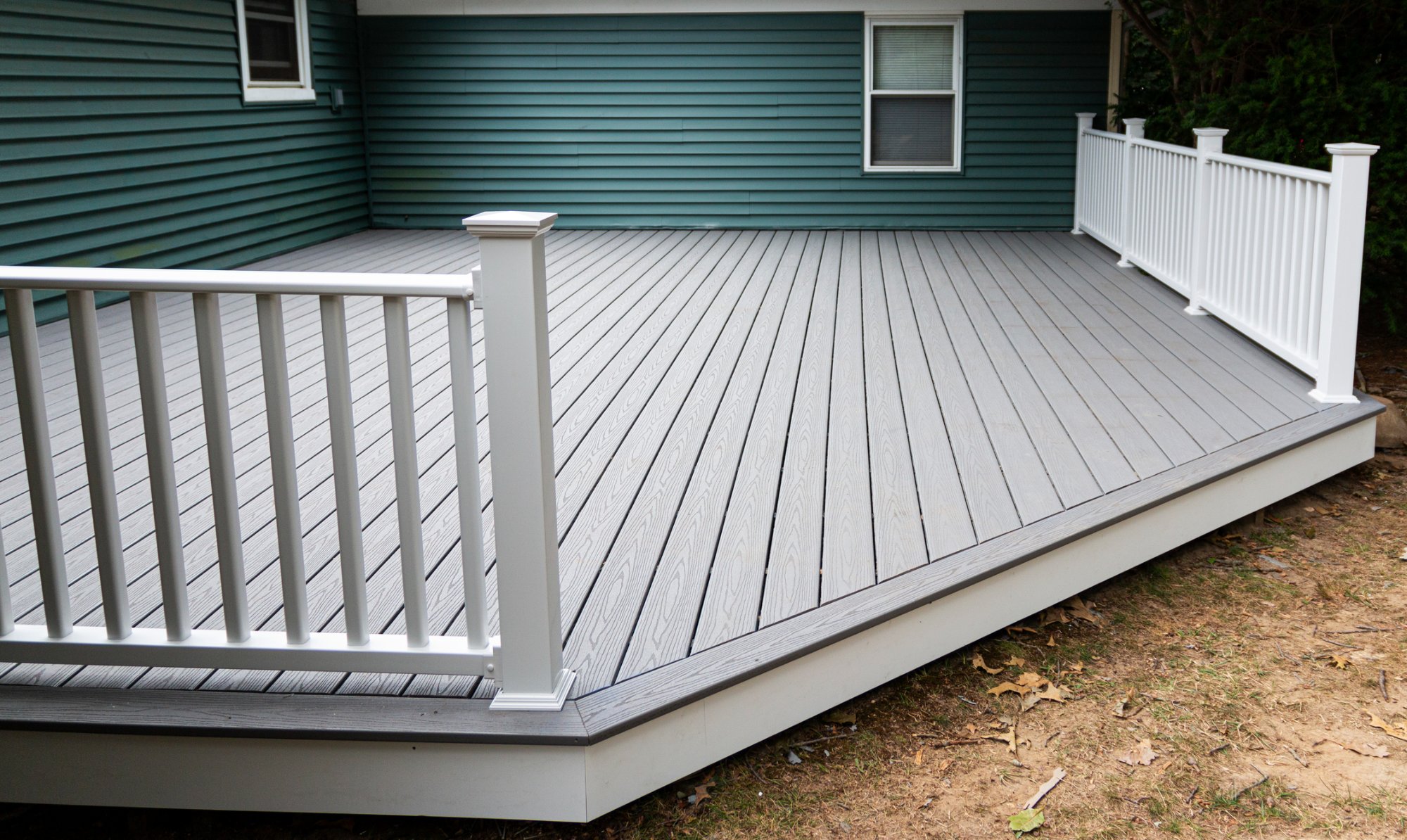
A Vermont deck is a structural project, not just a carpentry project. Frost-depth footings at 48 inches minimum, beam and joist sizing for 40–60 psf snow loads, ledger connections that are properly flashed and attached to structure - these aren't optional extras. They're the difference between a deck that performs for 30 years and one that pulls away from the house after five winters.
Forthright builds residential decks to code and to Vermont's actual climate requirements. We pull permits, coordinate inspections, and build the kind of deck that holds up under scrutiny and under snow.
Deck Options
Composite Decking
Trex, TimberTech, and Fiberon composite decking on pressure-treated framing. No staining, no splinters, no rot - annual cleaning only. The highest-value low-maintenance choice for Vermont homeowners. Hidden fastener installation for a clean surface without visible screws.
Pressure-Treated
Cost-effective and reliable. PT decking on PT framing - the standard Vermont deck. Requires cleaning and staining every 2–3 years to maintain appearance, but structurally sound and easily repaired. Good choice for budget-conscious projects.
Hardwood Decking
Ipe, Garapa, and other tropical hardwoods for homeowners who want natural wood with premium performance. Extremely hard and durable - handles Vermont conditions well with annual oiling. Available in hidden fastener systems.
Railing Systems
Pressure-treated, composite, aluminum, and cable railing - all installed to code (42" height for elevated decks, under 4" baluster spacing). Cable railing is increasingly popular on Vermont homes for its clean look and snow shedding. We through-bolt all railing posts - no surface-mount hardware.
Covered & Roofed Decks
Roofed deck structures - covered porches, pavilions, and pergolas - built to carry Vermont snow loads. Larger footings, heavier post and beam sizing, and a proper roof assembly. We assess permit requirements at the design stage; covered structures often require more involved review than open decks.
Second-Story & Elevated Decks
Elevated deck structures with under-deck drainage systems (DrySpace, Trex RainEscape) that convert the space below into covered patio area. Engineer review for complex structures and elevated decks over 10 feet.
How We Handle Vermont Deck Requirements
- Permits: We pull permits on all deck projects and coordinate footing, framing, and final inspections
- Frost-depth footings: 48-inch minimum depth, power-augered, inspected before concrete is poured
- Snow load framing: Beam and joist sizing calculated for Vermont ground snow loads of 40–60 psf
- Ledger flashing: Integrated with house wrap and siding - the most common failure point on Vermont decks, done correctly every time
- Post bases: Posts on hardware bases, never buried in concrete - buried posts rot from the bottom without showing any signs above deck level
- Stainless steel fasteners: Throughout all visible and structural connections - no electro-galvanized in Vermont's freeze-thaw environment
We sketch deck designs at the estimate stage at no cost - dimensions, access points, material options, and railing layout. If you have photos of decks you like, bring them.
Frequently Asked Questions
A basic pressure-treated deck (12x16 ft, ground level, PT railing) runs approximately $8,000 to $14,000 installed in Vermont. The same deck in composite decking runs $14,000 to $22,000. A larger deck with multiple levels, composite decking, cable railing, and stairs can run $30,000 to $50,000+. Covered deck structures (roofed porches, pavilions) add 40 to 80 percent to the base deck cost. Vermont pricing is higher than national averages because of frost-depth footing requirements, snow load framing specs, and permit/inspection costs. We provide firm fixed-price bids after a site visit.
Yes - we pull permits on all deck projects. In Vermont, attached decks almost always require a building permit. Second-story and elevated decks always require a permit. We handle the permit application, attend the footing inspection before concrete is poured, coordinate the framing inspection, and close out the permit at final. If your town has a longer permit review timeline (Burlington, South Burlington, and some Chittenden County towns can run 2–4 weeks), we factor that into the project schedule at signing.
A standard residential deck takes 3 to 7 working days for the construction crew, depending on size, complexity, and whether a covered structure is included. The full project timeline from signed contract to completion runs 3 to 6 weeks - accounting for permit review, material lead time (composite decking can have 1–2 week lead times), and crew scheduling. Footing concrete needs 3 to 5 days to cure before framing begins. We give you a detailed schedule at contract signing and communicate any changes proactively.
Trex, TimberTech, and Fiberon are all strong choices for Vermont. Trex is the most widely recognized brand with the longest track record - their Transcend line carries a 25-year fade and stain warranty. TimberTech's AZEK line is a capped polymer product (not wood composite) that is highly resistant to Vermont moisture and freeze-thaw, and many contractors consider it the premium choice. Fiberon is competitive on price with solid performance. All three are dramatically better than older-generation composite products. We're happy to show you samples of each at the estimate visit - color and texture vary meaningfully between lines.